Case Study
Posted on
Global shipping moves more than 90 per cent of the world’s traded goods, yet the industry faces increasing pressure to reduce fuel costs, cut emissions and improve safety at sea. Fuel typically accounts for more than half of vessel operating expenses, but most ships still use routing methods that prioritise shortest distance rather than real‑time ocean conditions. This often results in vessels travelling against currents and tides, increasing fuel consumption, emissions and wear on assets.
CounterCurrent was developed to address this challenge by rethinking how ships navigate the ocean. Originating from research led by Associate Professor Shane Keating at UNSW Sydney, the technology integrates advanced sensor data, satellite observations and artificial intelligence to produce hyperlocal, real‑time ocean forecasts tailored to individual vessels. By accurately capturing currents, tides, waves and other dynamic ocean features, the platform enables ships to work with the ocean rather than against it, improving efficiency without extending transit times.
The research underpinning CounterCurrent was translated toward application with support from Australia’s Economic Accelerator (AEA) Seed program. AEA Seed funding complemented UNSW‑led research and early translational efforts by helping bridge foundational research into an initial proof‑of‑concept, supporting early technical validation and initial engagement with end users. This contributed to de‑risking the technology at an early stage of its commercial pathway.
Following this early translation phase, the technology progressed into CounterCurrent as a UNSW spin‑out company. The platform reached early operational validation and has since been tested through modelling and pilot activity with international shipping partners. Results from early testing indicate that optimised routing informed by real‑time ocean conditions can deliver fuel savings of up to approximately 15 per cent on selected voyages, offering significant cost savings and corresponding reductions in greenhouse gas emissions.
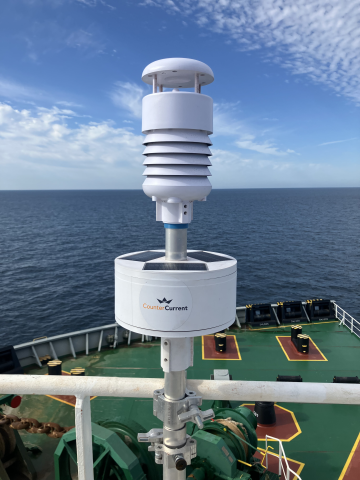
More recently, CounterCurrent has been conducting a paid pilot project onboard a 340‑metre Very Large Ore Carrier (VLOC) operating between Brazil and China. Over almost three completed round‑trip voyages, the vessel achieved average fuel savings of approximately 100 metric tonnes per voyage, translating to up to USD $200,000 in annual fuel savings for the customer and a reduction of more than 1,000 metric tonnes of CO₂‑equivalent emissions.
“On a single ship, we’re already seeing emissions reductions equivalent to removing around 50,000 trees’ worth of carbon from the atmosphere each year - roughly the number of trees across the entire City of Sydney,” said Associate Professor Shane Keating. “And that impact scales rapidly when you consider global fleets.”
Building on this foundation, the Trailblazer for Recycling and Clean Energy (TRaCE), part of the Australian Government’s Trailblazer Universities Program, has supported subsequent stages of CounterCurrent’s development. TRaCE support has focused on advancing product maturity, strengthening commercial capability and accelerating market readiness through a combination of R&D co‑investment, translation programs and early‑stage capital. This has helped move the technology beyond initial validation toward scalable, industry‑ready deployment.
Together, CounterCurrent, AEA and TRaCE show how complementary investment programs within Australia’s research and innovation ecosystem can work together to move high‑quality university research into real‑world use. Early translational support, followed by targeted technical and commercial acceleration, has helped CounterCurrent progress from a research insight to an emerging solution with the potential to deliver economic, environmental and safety benefits for global shipping.
Find out more: CounterCurrent
Keep up to date with other AEA funded projects: Funded Projects | Australia's Economic Accelerator